

- CollegeCentral Saint Martins
- CourseBA (Hons) Fine Art
- Graduation year2025
The Post-Granary Era is a research-driven creative project that investigates the structural rupture between the granary as a historical material space and contemporary ideological systems. As of summer 2025, the series comprises two principal works: Back to Granary for 3hrs, which revisits the displacement of crops from agricultural systems into the creative industries through a cultivation apparatus under artificial control; and # Field001, which uses a robotic arm to repetitively scatter seeds, simulating a labour mechanism recoded by technical logic and interrogating the restructuring of labour, time, and technology. The project also includes associated writing and academic research.
Framed as art-based research across economic history, political economy, and ideology critique, the series links the dimensions of “growth” and “labour” to explore, through the lens of Marxist labour theory, how labour and exploitation are ideologically reconfigured amid economic development and industrial transformation.
Final work

Back to the granary for 3 hours
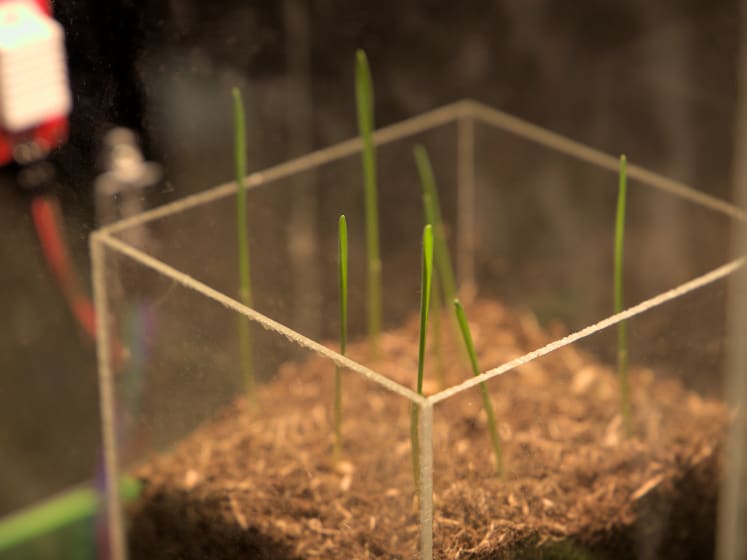
Back to Granary for 3 hrs is a research-based, site-specific installation that symbolically returns wheat from Lincolnshire—historically the grain source of London—back to the Granary Building, now home to Central Saint Martins. The project traces how spatial infrastructures shift from agricultural logistics to nodes of creative production, thereby exploring how material systems are transformed into symbolic economies.
The work is inspired by the Granary Building’s industrial past and the capital structures that continue to operate beneath its cultural functions. By cultivating wheat under tightly regulated temperature, humidity, and light conditions—and compressing a full day’s growth cycle into 200 seconds—the installation seeks to metaphorically reflect how both industrial agriculture and creative labour are subsumed into systems of optimisation, extraction, and control.
In the production process, I retrieved wheat directly from Lincolnshire, built a controlled plant chamber equipped with sensors and lighting systems, and embedded it into an exhibition structure in which the spatial logic of “monitoring–display” itself becomes part of what is seen. The theoretical framework ranges from Marx’s “metabolic rift” to Timothy Morton’s “hyperobjects”, using the formal language of agriculture and growth to critically reconstruct the institutional structures and perceptual mechanisms of post-capitalist contexts.
This project asks: under the broader conditions of economic development and industrial transformation, has the nature of labour fundamentally changed? Within systems where visibility, productivity, and temporality are all preconditioned by institutional logics, does space still possess the capacity to produce? The work seeks to expose fissures between time, system, and land.

Back to the granary for 3 hours
Research and process
Share this project
A link to this page has been added to your clipboard