
- CollegeLondon College of Fashion
- CourseMA Fashion Marketing and Sustainability
- Graduation year2025
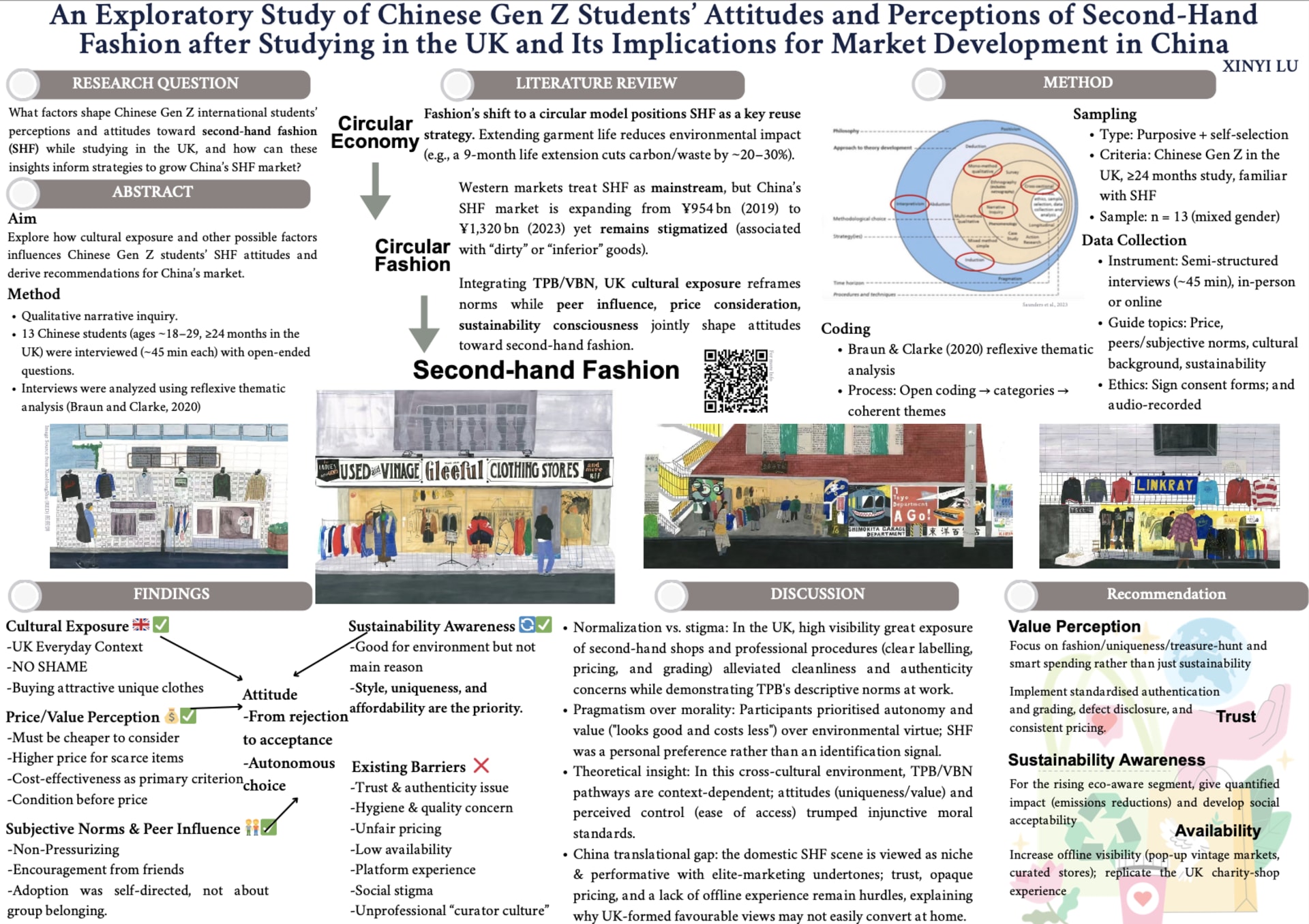
This study explores what factors shape Chinese Gen Z international students’ attitudes toward second-hand fashion (SHF) while studying in the UK. It also explains how these insights can help develop the SHF market in China. The research is based on thirteen semi-structured interviews that examine how students’ views and experiences changed across cultures.
The findings show that students were first resistant to SHF because of hygiene concerns, doubts about authenticity, family disapproval, and low trust in resale platforms in China. In the UK, they were exposed to a more transparent and normal second-hand system, including charity shops, vintage boutiques, and online resale apps. This new experience made SHF appear fashionable, affordable, and socially accepted. The main drivers of positive attitudes were price, uniqueness, and peer influence. Environmental motives were present but not strong.
Several barriers were identified in China, including unclear pricing, weak product authentication, limited offline access, and an elitist “curator culture.” The study refines the Theory of Planned Behavior by showing that descriptive norms are more influential than moral pressure. It also finds that sustainability beliefs play a smaller role than expected. In practice, building trust, improving store access, and ensuring clear value are key steps. These practical changes can encourage Chinese Gen Z consumers to engage with SHF and support sustainable fashion.
Final work
Share this project
Chinese Gen Z Attitudes Toward Secondhand Fashion
This study explores what factors shape Chinese Gen Z international students’ attitudes toward second-hand fashion (SHF) while studying in the UK. It also explains how these insights can help develop the SHF market in China. The research is based on thirteen semi-structured int...
A link to this page has been added to your clipboard