Showcase

Materials in Flux

Wies Roeterdink

Profile picture of Wies Roeterdink

Wies Roeterdink is a Dutch London-based artist whose practice encompasses a wide range of artistic mediums from sculpture to performance which engages with the ephemeral and the ambient.

In its impermanent nature, her work is concerned with the transiency of existence, the ephemerality of everyday experience, the impact of incidental light on the composition of architectonic structures, the body as an interface for experience and meaning, as well as destabilisation of dominant concepts of structuring the phenomenal world. To realise these concepts, she turn to processes such as casting using handmade paper, sculpting using reclaimed unfired clay, cyanotypes, and combining bioplastics with printmaking. Their materiality is what fascinates her, it is one which holds many potential forms. In their unfixed state, sculptures are vulnerable to change: the bioplastic cracks, the clay fractures, and the paper pulp dissolve. As such, documentation has consistently played an integral role in her practice.

The impermanence of her sculptural works generates a possibility for a form of sculpture which challenges traditional notions of conservation and permanence. Within her work, she is increasingly trying to acknowledge the various durational and temporal registers of materials in flux. She attempts to hold her work in the speculative phase - not focused on a representational sculpture of a thing, rather she uses materials to interface with immaterial conditions, like duration and light.

Wies Roeterdink is a Dutch London-based artist whose practice encompasses a wide range of a...

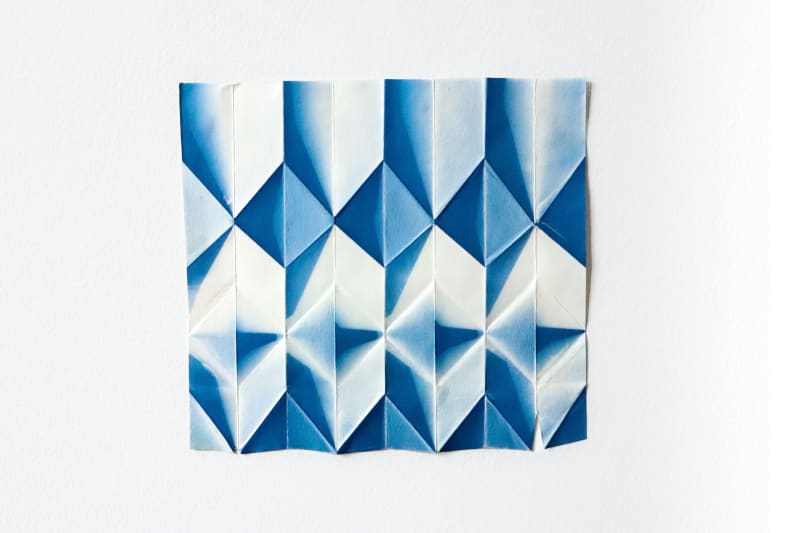
These sculptural prints exist as micro-archives recording the movement of light across a plane - they are concerned with the mediatisation of transitory phenomena.

Through its directness, cyanotype as a process ensures a quantifiable record of an object’s exact scale, presence, and solidity, acting as a record of the real. What then happens when you remove the object in its entirety and instead allow the folded paper to become the object which casts shadows on itself? Diverting from the traditional cyanotype process, which utilises a negative image, I considered the sculptural possibilities of folded photosensitive paper to generate its own light history.

In their flattened states, the prints become objects which hold within their surface the memory of three-dimensional space (that has reverted back into flatness, a sheet) through an archive of specific light and shadow. The blue monochromatic results encourage conceptual thinking on the inherently ephemeral nature of light.

Final work

On a white square ceramic tile, there is an image of a crouched back surrounded by a circular pool of blue bioplastic material.

Anthropometry in Blue (2023), detail

Bioplastic Cyanotype on Found Tile, 15 x 15 cm

Blurring the intersection between science and art, my recent experiments creating bioplastic cyanotypes offered a critical opportunity to interrogate the materiality of images. Plastic image-making allows for mimesis, impressions, and copies. The relationship between plasticity and mediums of reproduction (photography and printmaking) resonates. In concentrating on the material as an articulate image, I locate the image embedded within the material itself, not dependent on a fixed surface. The imprint is internalised at a molecular level.
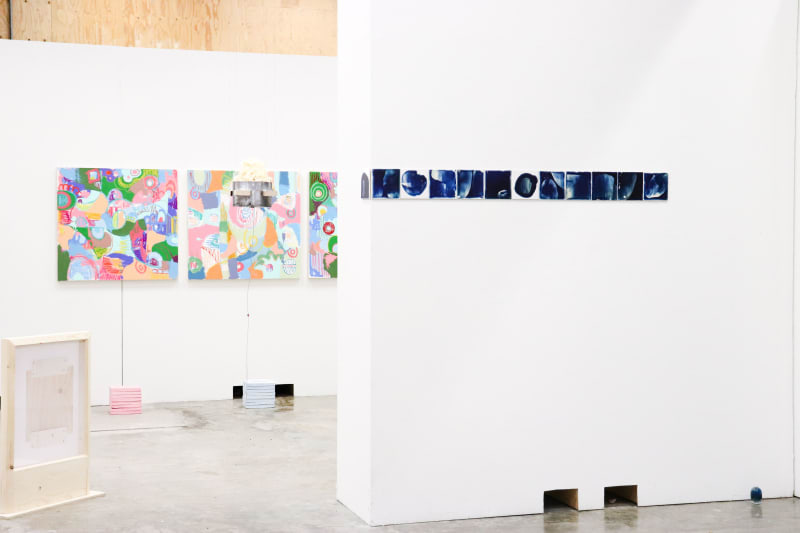
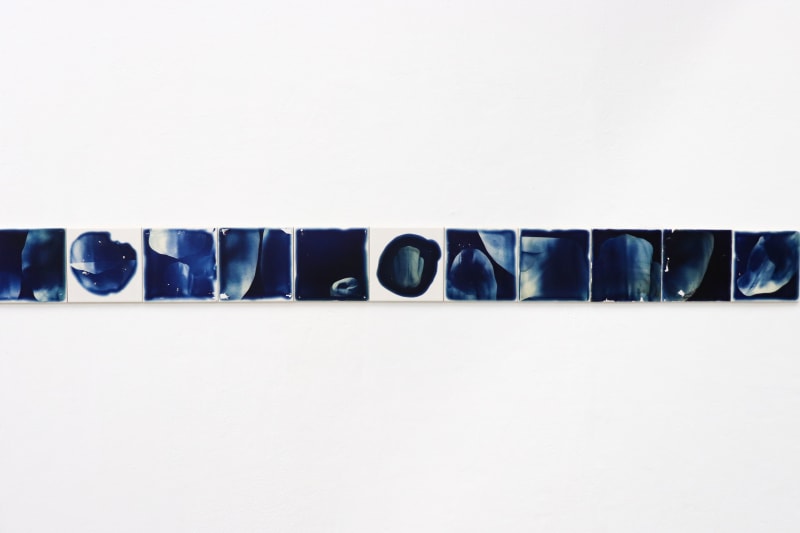
  • Twelve small ceramic tiles are arranged horizontally on a white wall. The surface of the tiles is coated in a blue bioplastic and images of the body.
  • Twelve small ceramic tiles are arranged horizontally on a white wall. The surface of the tiles is coated in a blue bioplastic and images of the body.
  • Two images, both contain blue fragmented sections of the female body
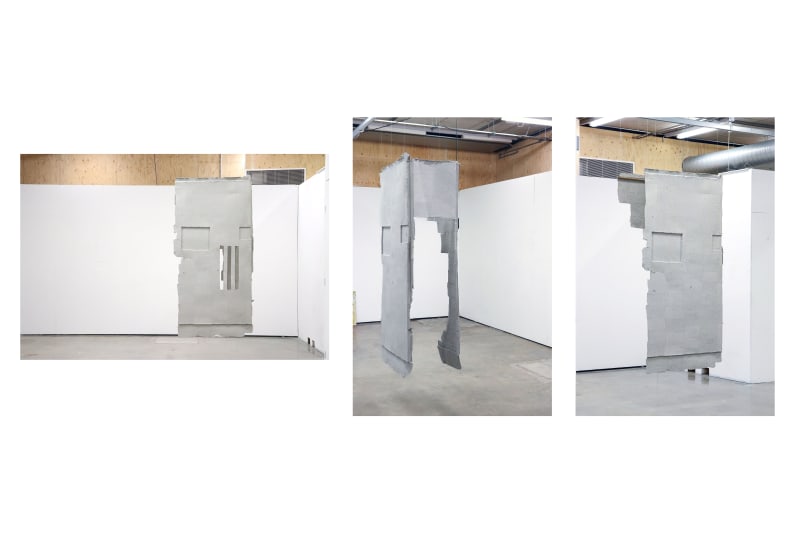
  • Large handmade paper cast of a hallway is flattened and hung against a white wall.
  • Three images of a handmade paper cast of a hallway suspended from the ceiling in the studio.
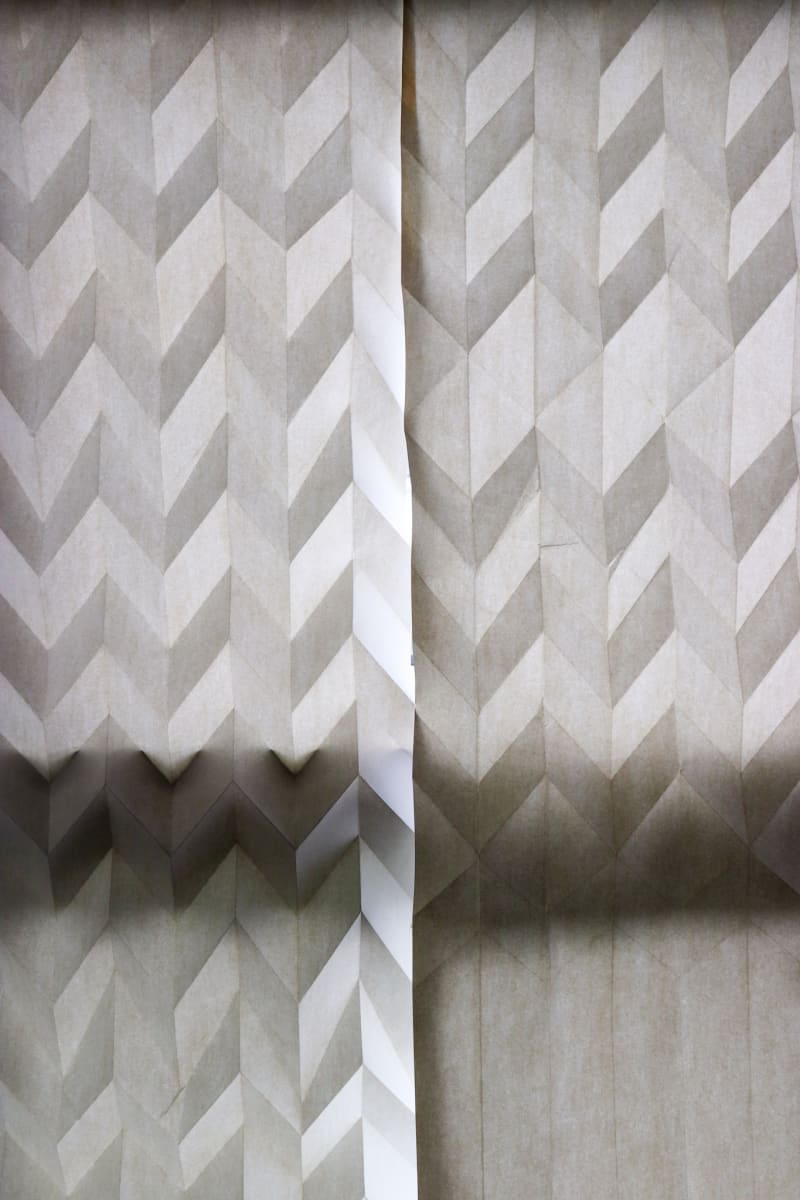
  • A3 diagonally pleated paper print with blue gradients on the folds emphaising their depth
  • A5 folded paper with blue geometric triangular pattern
  • A5 folded paper with blue kite-shaped prints decreasing in scale down the page.

Research and process

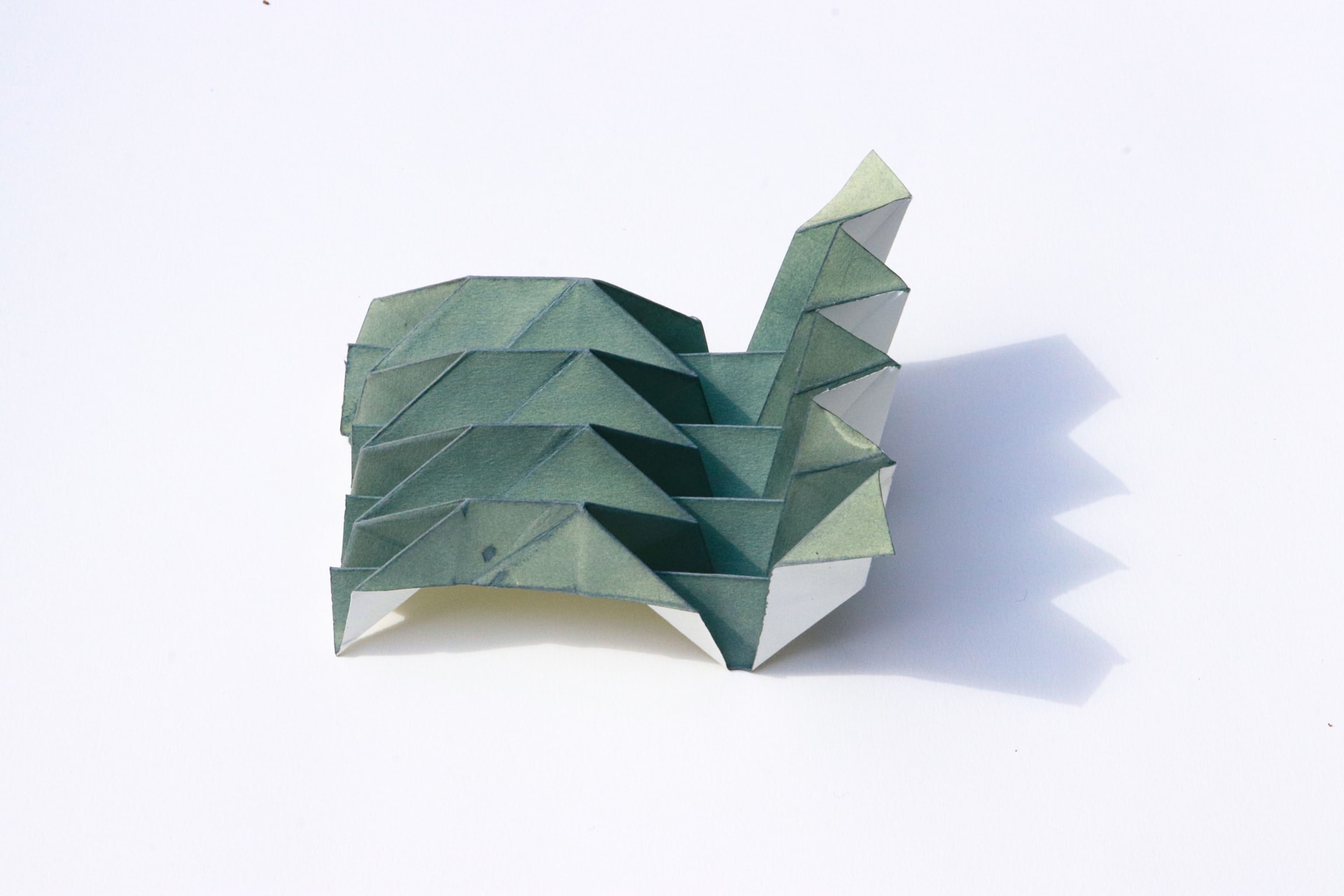
Pleated geometric origami sculpture which angles upwards towards the right.

Folded Cyanotype (No. 5), During Exposure

  • 3 long pieces of paper at different stages of folding are hung at staggered heights against the wall
  • Long piece of origami paper sculpture on carpeted floor adjacent to window.
  • 2 sheets of geometrically folded paper hung against window. Light shines through the paper, emphasises the folds.

Share this project

Materials in Flux

These sculptural prints exist as micro-archives recording the movement of light across a plane - they are concerned with the mediatisation of transitory phenomena. Through its directness, cyanotype as a process ensures a quan...

A link to this page has been added to your clipboard