
- CollegeCentral Saint Martins
- CourseMA Biodesign
- Graduation year2025
This project, grounded in nonhuman-centric thinking and Jakob von Uexküll’s theory of Umwelt, investigates how space—particularly domestic space—is defined, bordered, and policed through divergent perceptual systems.
Human spatial logic is structured around cleanliness, order, and control. Through architecture, regulation, and everyday practices of hygiene, inhabited space becomes a site of inclusion and exclusion: of who belongs, and who must be removed.
The spider, with a perceptual system fundamentally different from ours, is often classified as a pest—not for its actions, but for its appearance in the “wrong” place. Its presence violates an aesthetic and symbolic order, revealing the fragility of our spatial control.
This project reverses the gaze. Through the spider’s sensory logic, it asks: how is the human sensed? What residues do we leave behind?The work does not aim to mimic spider perception, but to let it intersect with ours—exposing how spatial authority is constructed and asking what it means to share space across species boundaries.
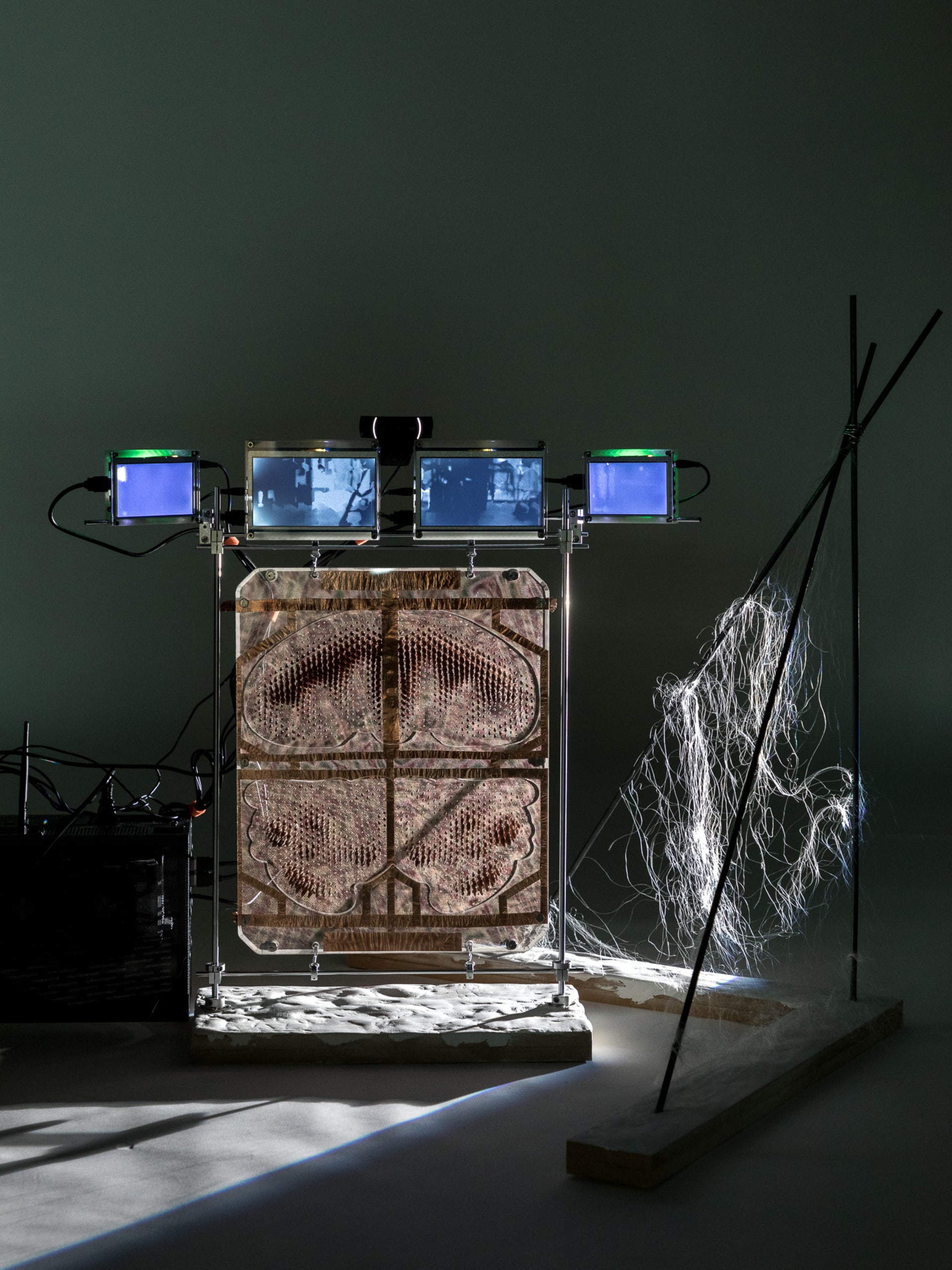
Final work

This project does not serve a defined audience. It is not meant to instruct, persuade, or resolve. Instead, it unfolds as a speculative gesture—one that invites you to confront the discomfort of being perceived by something you cannot understand. In the architectural systems we call home, we are taught to master space: to organize, clean, control. But in doing so, we create hierarchies of presence—those we welcome, and those we reject. The spider, quietly weaving its web in the corner, is not an intruder. It is simply operating within its own Umwelt, its own logic of space-making. This installation proposes a subtle reversal: what if your presence, your movements, your scent, became the anomaly in someone else’s perceptual world? What if the home you claim as sovereign was already inhabited—not by pests, but by other lives with other ways of sensing, mapping, and claiming space? In touching the setae structure, you are not “activating” an object. You are being sensed. In appearing on the screen, your chemical trace becomes readable—not to you, but to a system modeled on the spider’s chemosensory Umwelt. This is not a translation. It is a frictional encounter. A moment of mutual illegibility. And perhaps, after this encounter, when a nonhuman form appears again—in your bathtub, behind your bookshelf, suspended in the light—you will hesitate.Not to scream, not to kill, but to wonder: Who has the right to call this space home?
Share this project
A link to this page has been added to your clipboard