

- CollegeCentral Saint Martins
- CourseMA Biodesign
- Graduation year2025
Due to climate change, we are experiencing more and more heatwaves, with temperatures reaching concerning levels in environments that are not equipped for such challenges. What if we could turn to nature for solutions? Learn from organisms that evolved in extreme environments. Cataglyphis bombycina, the Saharan silver ant, is one of the few organisms able to forage under peak desert heat, avoiding predators that retreat into the shade. Its secret lies in a dense array of triangular, hairlike structures covering the ant's body that reflect solar radiation and reduce heat absorption.
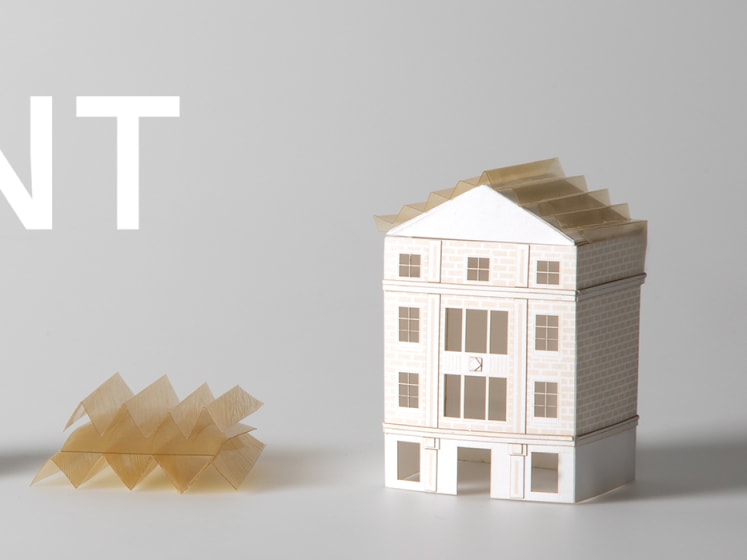
Inspired by this fascinating adaptation, Triant is a research project that explores how bioinspired materials and micro-fabrication technologies can help us develop passive thermal shielding systems for human environments. By studying the ant’s microstructures, the project seeks to translate natural innovation into sustainable, heat-resistant solutions for our built world.
A special thank you to Serge Aron, Priscilla Simonis, Alisha Hunter, and Dr.Florent Seichepine for their invaluable support and collaboration throughout this project.
Final work

IMPRINTED CHITOSAN MATERIAL [250μm grooves]
This chitosan imprinted material features microscale surface structuring achieved through femtosecond laser processing moulds [Femtosecond micromachining laser - Bionanofabrication core facility]. Originally designed to mimic thermoregulating and light-scattering properties found in nature, the material exhibits enhanced optical behavior due to precisely patterned features.

IMPRINTED CHITOSAN MATERIAL [150μm grooves]
On this second imprinted sample, structural colors become visible, revealing the interaction between light and the engineered microstructures. These colours result from interference effects, demonstrating how the patterned chitosan surface manipulates light at the microscale.

METAL MOULD [25μm]
Some of the metal moulds with microscale grooves exhibit the formation of structural colours, as seen in this example. Engraved using the femtosecond laser [Femtosecond micromachining laser - Bionanofabrication core facility]. These mould were then used to imprint the microstructure onto the chitosan based material.
Research and process

NATURE'S STRATEGY: THE SAHARAN SILVER ANT
The Saharan Silver Ant, also known as Cataglyphis bombycina, is an ant that can be found in the Sahara Desert. This ant is capable of foraging during the hottest parts of the day when most predators retreat to the shade.
The ant’s body is covered in hairlike structure that scatter and reflect sunlight, helping to keep it cool.

MICROSCOPIC IMAGE OF ISOLATED ANT HAIRS
Share this project
A link to this page has been added to your clipboard