
- CollegeLondon College of Communication
- CourseMA Design Management
- Graduation year2025
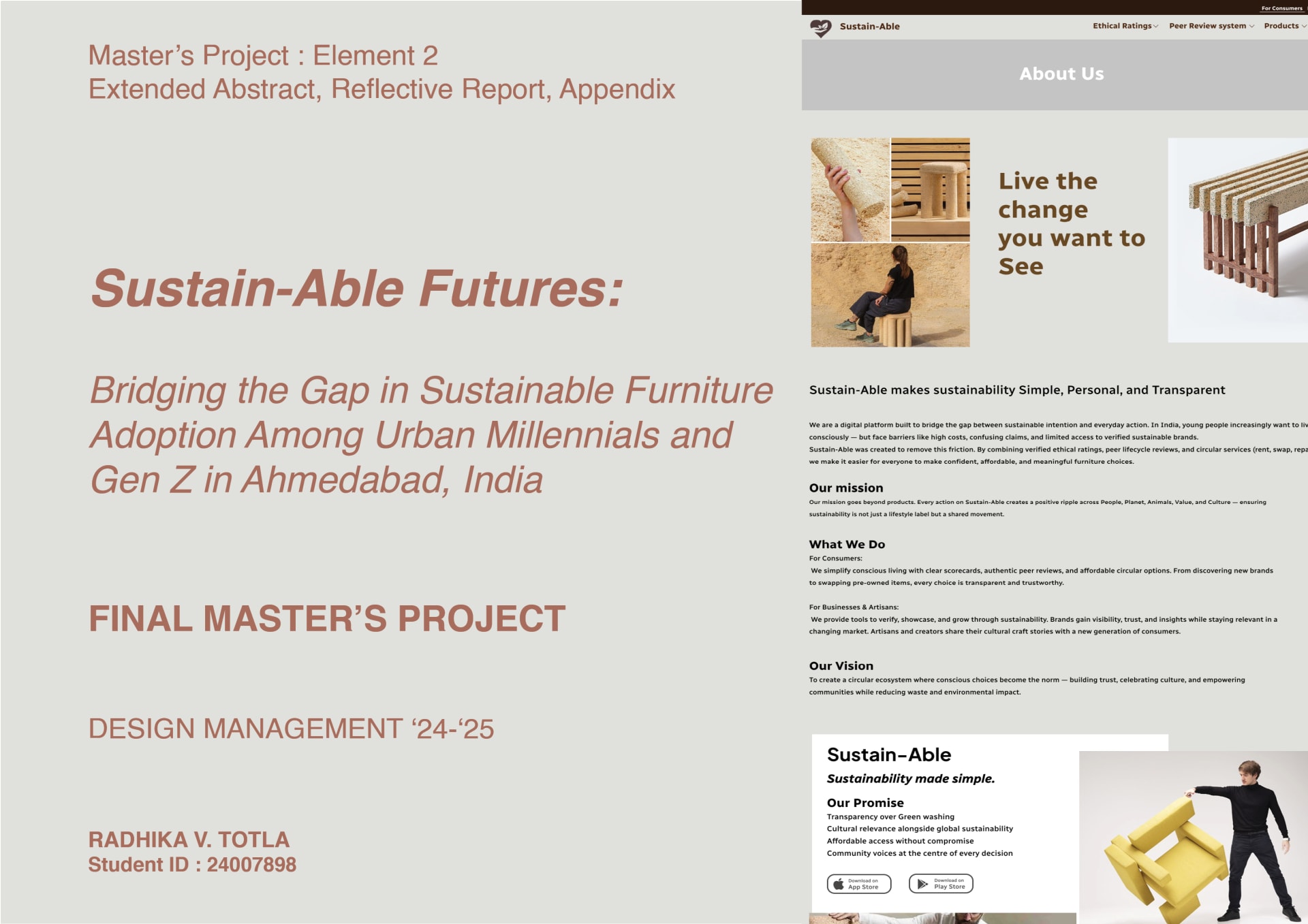
Bridging the Gap in Sustainable Furniture Adoption Among Urban Millennials and Gen Z in Ahmedabad, India
Sustain-Able is a mobile-first digital platform designed to make sustainable furniture more accessible to Millennials and Gen Z in India. The project addresses systemic barriers, including perceived affordability, trust, accessibility, and cultural stigma, reframing sustainability as a mainstream, value-driven lifestyle practice.
The platform integrates features that directly respond to user needs uncovered through research. These include verified brand directories and sustainability scorecards to build trust and transparency, a peer-to-peer marketplace to improve affordability and access, and three-stage product lifecycle peer reviews that highlight durability and long-term value. Additional tools such as comparison features, savings and impact calculators, and storytelling spaces further strengthen informed decision-making. On the business side, homepages, verification badges, and support insights help brands maintain authenticity and relevance.
Research through surveys, interviews, and case studies (IKEA, Sirohi, AKFD, Veja, Good on You) informed feature development. The design process combined user personas, empathy maps, journey maps, and iterative prototypes to ensure a centralised, user-friendly, and culturally contextual solution. Testing (SUS 77–87) confirmed the usability and appeal, positioning design management as a systemic orchestrator that bridges consumer behaviour, cultural values, and circular economy practices.
Final work
Web - based Platform : Sustain-Able
Sustain-Able is a mobile-first platform built to empower young Indian users to make sustainable furniture choices that are affordable, trustworthy, and culturally resonant. Grounded in user research, it tackles key barriers such as perceived affordability, trust, access, awareness, and emotional connection. The platform integrates verified content, peer validation, and circular economy features to support everyday conscious decisions.

Problem Statement, Research Question, Aim, Objectives and Stakeholder Map

Design Process and Outcome

Impact, Implications, Conclusion and Next Steps
Research and process

Research Process and Main Insights
Share this project

A link to this page has been added to your clipboard