

- CollegeCamberwell College of Arts
- CourseBA (Hons) Fine Art: Sculpture
- Graduation year2025
Upside-Down, Inside-Out and Moving, 2025 explores the quiet persistence of nature and the entangled relationship between organic life and industrial structures. The title is taken from a chapter in Why Look at Plants? (2018) by Giovanni Aloi, which explores vegetal perspectives, bodily metaphors, and the repositioning of plants in contemporary art and theory.
A Common Lime tree, suspended upside-down within a steel frame, is held in a state of tension, its twigs coated in red-dyed gelatine prosthetics that drip slowly, as if bleeding or reforming. These fleshy, fragile extensions suggest a wounded organism regrowing, not passively, but persistently.
Below, cracked tarmac embedded with dark wax and soil appears fractured by unseen root pressure. Seeds lie between the breaks as symbols of resistance held in potential. Around and beneath the tree, construction materials such as metal flat bars, aluminium tubes, and bolts intertwine with natural substances like coffee grounds and Thai inhaling herbs.
Through this lens, Upside-Down, Inside-Out and Moving reflects on the quiet persistence, adaptation, and slow reclamation of nature. The sculpture exists in a state of contradiction: structured and ruptured, restrained and regenerative. Nature here does not scream, it leaks, cracks, shifts, and grows.
Final work

Upside-Down, Inside-Out and Moving, 2025
Upside-Down, Inside-Out and Moving by Pinn Satjawattanavimol
The sculpture features a real tree, approximately 2.5 metres tall, suspended upside down within a large metal frame. The tree is a Common Lime, its trunk pointing toward the ceiling, and its leafless branches hanging down toward the floor. The tree’s thin twigs are coated in a translucent, soft, dark red material as gelatine that glistens slightly, some parts appearing as if slowly dripping.
The structure holding the tree is made from flat metal bars, joined together with visible nuts and bolts. Three long aluminium tubes extend vertically from the top edges of the frame, each about 2.5 metres high. They curve outward at the top in a 90-degree bend, suggesting an architectural or skeletal presence. The overall structure is geometric and industrial.
Below the hanging tree is a section of dark flooring, about the size of a small rug. It is made from black tarmac mixed with dark green wax. The surface is cracked in irregular patterns, mimicking the way roots break through pavement. Inside these cracks is dark soil, and small seeds are embedded in the gaps present as part of the installation.
The entire work leans subtly in one direction to the southwest to reflecting the artist’s research into natural orientation and tree growth. The atmosphere of the piece is quiet, fragile, and reflective. The structure appears simultaneously delicate and engineered as suggesting tension between natural life and human construction.


The gelatine prosthetics are a result of long-term material experimentation. Over the past year, developed and refined a sustainable, bio-based recipe that mimics skin and internal tissue. The process involved testing temperature, pigmentation, and movement especially how it ages, dries, drips, and reacts to gravity. Dyed with natural colourants from avocado, the material speaks to bodily transformation, impermanence, and the slow organic memory of the sculpture.

Upside-Down, Inside-Out and Moving, 2025
Cracked black tarmac mixed with dark green wax. Mimicking the way plant roots break through urban ground that resemble the pressure of roots pushing from underneath. Within the cracks lies soil, and small seeds, subtly placed and hinting at growth. The contrast between the hard, industrial surface and the soft, organic materials beneath creates a quiet tension. This part of the sculpture suggests that even under pressure or constraint, natural life finds a way to emerge, gently challenging the permanence of human structures through slow, silent force.
Research and process

Material test
Experimenting of gelatine prosthetics and red dye avocado.
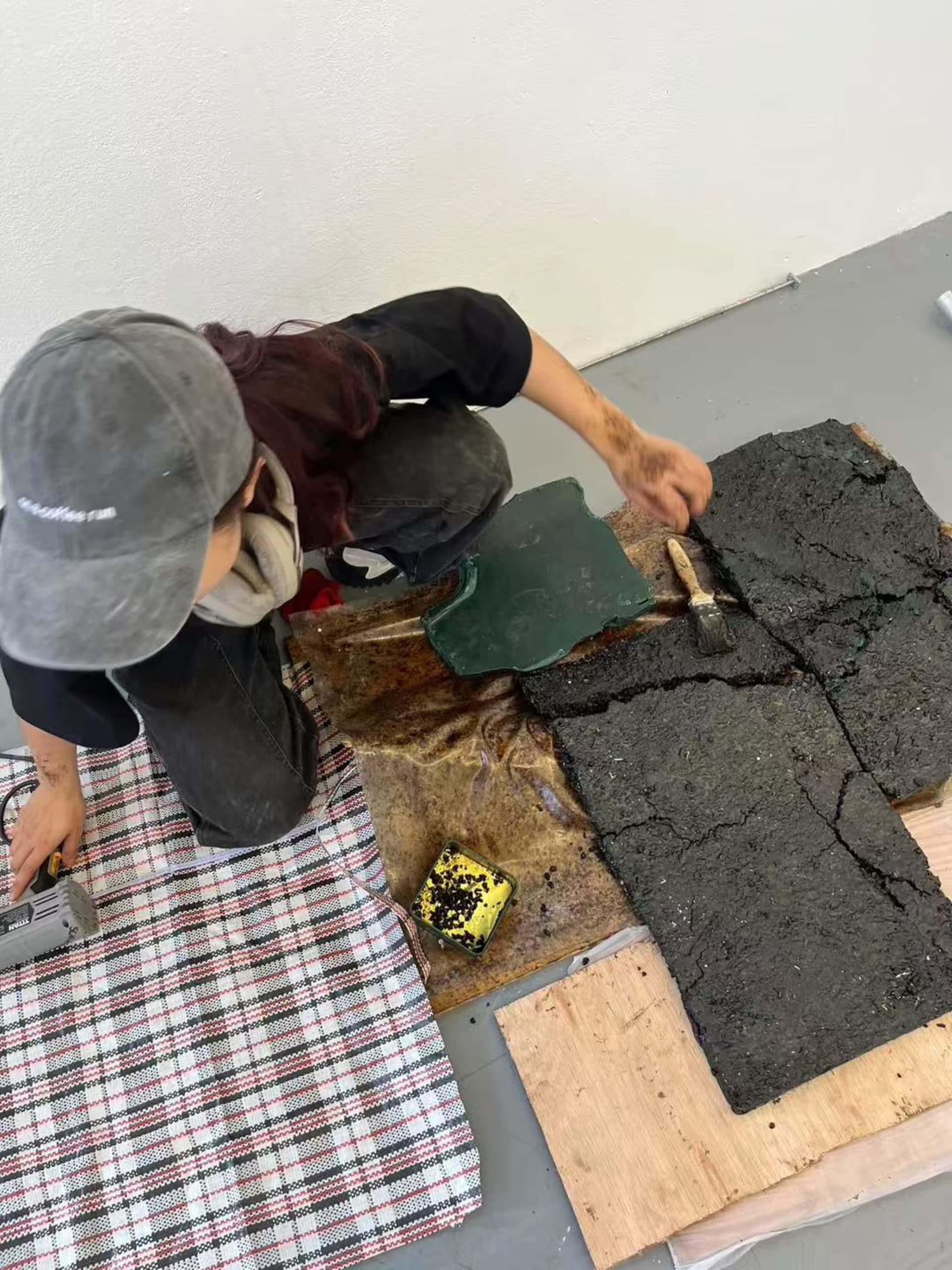
Process of tarmac tiles
Applying melted wax on tarmac tiles
Share this project

A link to this page has been added to your clipboard