

- CollegeUAL Creative Computing Institute
- CourseMA/MSc Computing in the Creative Industries (Modular)
- Graduation year2025
While it looks like a hand, it thinks like an octopus. This artifact explores...
What if your arm could think for itself? The H.A.N.D. project explores the "alien intelligence" of the octopus. Unlike humans, who rely on a single central brain, an octopus has a brain that is spread out—two-thirds of its neurons are actually in its arms. This project translates that biological strategy into a soft robotic sculpture.
The artifact consists of five soft, silicone digits that act as independent agents. Instead of being told what to do by a central computer, each digit "senses" the world through light and decides how to move on its own. They communicate with their neighbors to create fluid, organic ripples of movement—curling up for camouflage in bright light or relaxing in the dark.
Final work
H.A.N.D. (Hybrid Autonomous Neural Digits)
How does a decentralized mind see the world?
Using generative light fields created in TouchDesigner, I exposed the H.A.N.D. to complex visual noise. Watch closely: there is no central computer choreographing this motion. What you are seeing is the raw, emergent behavior of the silicone body making sense of the light in real-time.


Research and process


Share this project
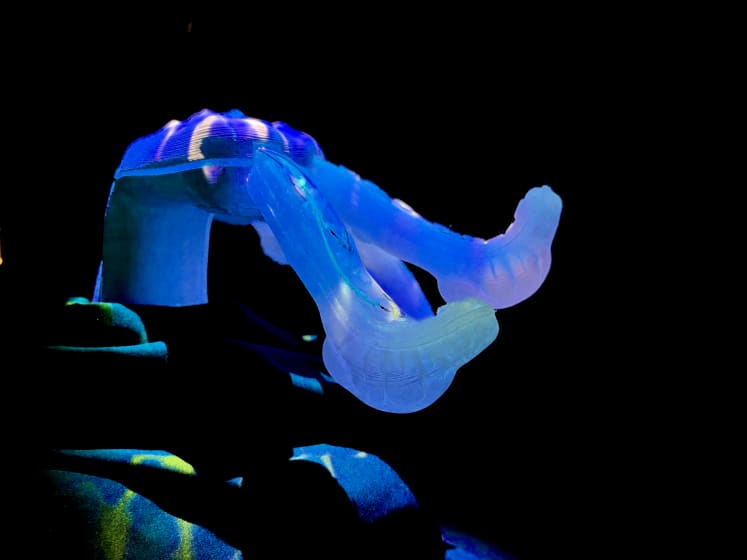
The H.A.N.D. --- (Hybrid Autonomous Neural Digits)
While it looks like a hand, it thinks like an octopus. This artifact explores...What if your arm could think for itself? The H.A.N.D. project explores the "alien intelligence" of the octopus. Unlike humans, who rely on a single central brain, an octopus ha...
A link to this page has been added to your clipboard