
- CollegeLondon College of Fashion
- CourseBSc (Hons) Fashion Management
- Graduation year2025
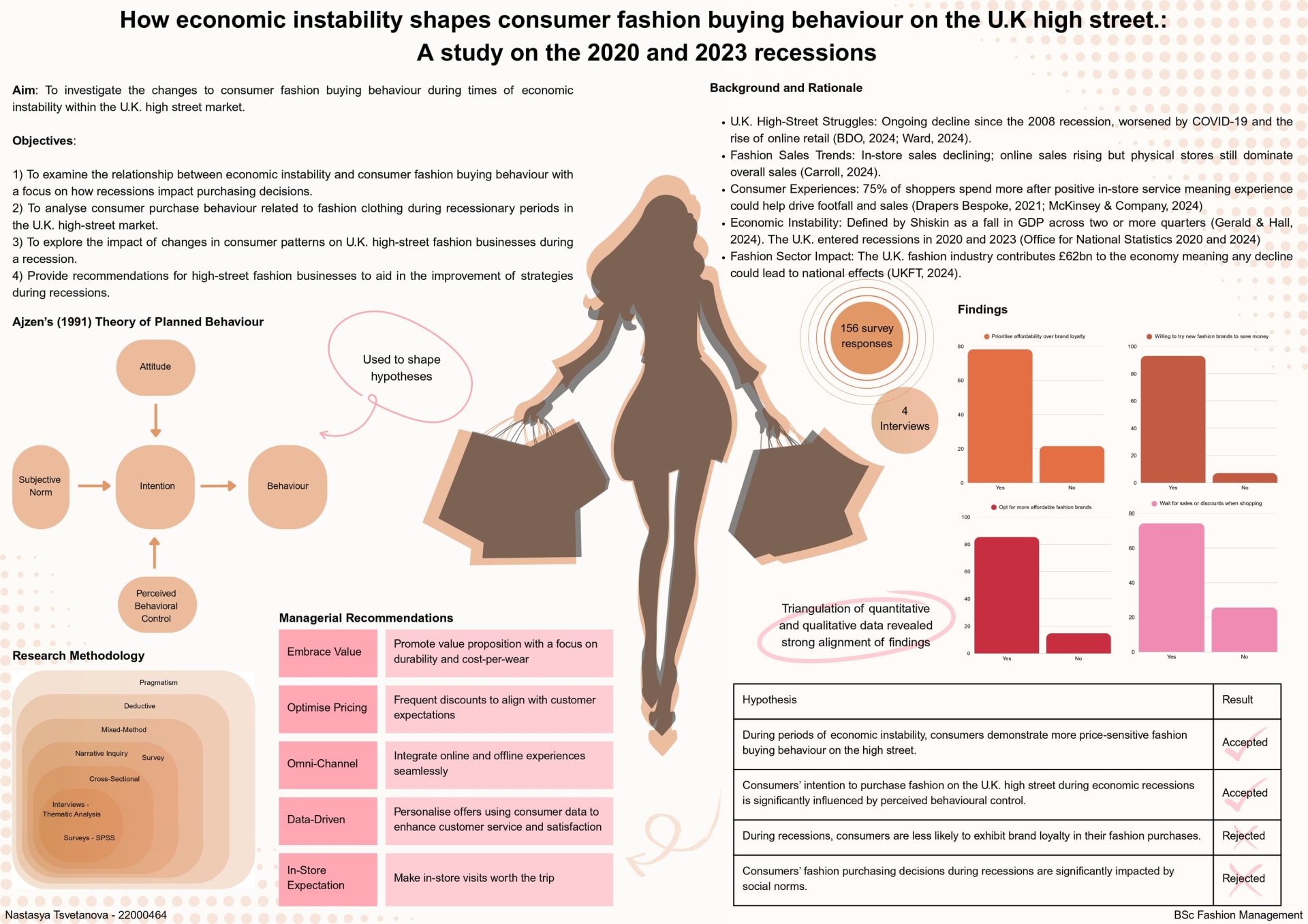
This showcase illustrates an academic poster summarising the findings from the dissertation. The study investigated how economic instability, specifically the 2020 and 2023 recessions, influenced consumer fashion buying behaviour on the U.K. high-street and its implications for retailers. Consumer spending plays a vital role in the economy, and the U.K. high-street retail sector has faced struggles since the 2008 financial crash, with in-store fashion sales declining. Recessions, typically defined as a fall in gross domestic product over two or more successive quarters, can significantly impact consumer behaviour due to financial strain, stress, and uncertainty. The study used a pragmatism philosophy and a deductive approach, framed by Ajzen’s Theory of Planned Behaviour, which considers attitudes, subjective norms, and perceived behavioural control as influences on purchase intention and behaviour. A cross-sectional study was completed using a mixed-methods approach, combining a quantitative survey and qualitative interviews with high-street retail workers.
The quantitative analysis found that consumers become significantly more price- sensitive during recessions. Perceived behavioural control also significantly influences purchase intention, with confidence in affording fashion impacting intention to purchase. Contrary to expectations, the relationship between brand loyalty and purchase intention was found to be a slight positive correlation, however these results were more nuanced. Social norms were not found to have a statistical impact on purchase intention.
The qualitative analysis revealed a noticeable decrease in consumer spending and in- store footfall. Consumers became more price-conscious, prioritised basic and re- wearable items, and adopted new shopping habits, including increased online shopping. Retailers responded by increasing sale frequencies, enhancing visual merchandising, focusing on customer engagement and digital marketing, and in some cases, closing stores.
Triangulation showed strong alignment between the quantitative and qualitative data. The nuanced findings on brand loyalty from the quantitative analysis was supported by the qualitative data and secondary research. The study provides insights into the evolving consumer behaviour and retailer adaptations during economic downturns.
Key Words: Economic Instability, Recessions, Consumer Behaviour, Fashion, U.K. High-Streets
Final work
Share this project

A Study on the 2020 and 2023 Recessions
This showcase illustrates an academic poster summarising the findings from the dissertation. The study investigated how economic instability, specifically the 2020 and 2023 recessions, influenced consumer fashion buying behaviour on the U.K. high-street and its implications fo...
A link to this page has been added to your clipboard