

- CollegeLondon College of Communication
- CourseMA Photojournalism and Documentary Photography
- Graduation year2025
‘Hanns Kralik: Germination’ examines the social processes surrounding the rise and fall of the German revolution through the life of the artist and miner Hanns Kralik. Active as a member of the German Communist Party, Kralik developed a sharply satirical visual language, adopting the role of regional agitprop secretary. By 1933 the fascists incarcerated Kralik in the Börgermoor concentration camp, located in Northern Germany, where he illustrated the first songsheet behind the anti-fascist anthem “Die Moorsoldaten”. Kralik survived Börgermoor; his lifelong motto, taken from Karl Liebknecht's final speech, became “We are not smashed, we live [...] in spite of all!”
Final work

View of the Ruhr from the Haniel Colliery slagheap
The Ruhr region has been hammered into shape by over a century of industrial mining. The scale of production has had a distinct impact on the landscape, in parts of the Ruhr the ground has sunk as much as 98 feet. Hanns Kralik the artist and revolutionary, spent his formative years as a miner working in the Haniel colliery, today the mining waste from the colliery makes up an artificial hill or slagheap over 185 metres high, the product of generations of labour.

Landschaft Park Duisburg Nord, AG Phoenix steel plant
Located in the centre of the city of Duisburg, the abandoned relic of the AG Phoenix steelworks serves as an imposing and period accurate insight into the conditions in which Kralik laboured for a year in the local steel industry while working as an art student and for the German Communist Party in 1923.

AG Steelworks Blast Furnaces
Kralik briefly describes his experience of hyperinflation and lying low in the Duisburg steel industry following a brief episode of streetfighting between government forces and local miners.
"The strike was stifled, and the hunt for the ringleaders began. I managed to escape. […] At the same time, inflation reached its peak; when a single cigarette cost billions, the devilish game with zeros came to an end. In the end, the rich had become even richer and the poor even poorer. [...] My work papers were by then completely ruined, I was finally locked out, and couldn't find work anywhere in the mining industry. Only after months did I find work again in the Duisburg steel industry. First in the rolling mill, then at the dome furnace, on the various fine and high-speed production lines. Continuing my studies was now particularly complicated; an additional stop was added: the 35 km commute from work to home and from school to work. Once again, I managed to get the night shift."
(Kralik, H., Kopp, H. and Stein, K. (2011) Hanns und Lya Kralik - Kunst und widerständiges Leben. Essen: Neue Impulse Verlag. pp. 22-23)

Shaft IV
In 1914 Kralik, aged only 14, began work in the Haniel mines. Just under ten years later in 1923 alongside the rest of the miners at Shaft IV, Kralik participated in a blockade and occupation of the mine. In an episode that reflects the broader revolutionary aspirations of the working class at the time and the lack of a wider leadership to actively connect the widespread pockets of class battles he recounts his experience in his memoir.
"They advanced with machine guns and cannons, arrested the entire works council and a large portion of our union officials. Despite vigorous protests, the arrested men were to be transported to Belgium. The wagons were stormed, some of the miners were freed, but there were deaths and injuries in the ensuing firefight." (Kralik,2011)
Research and process
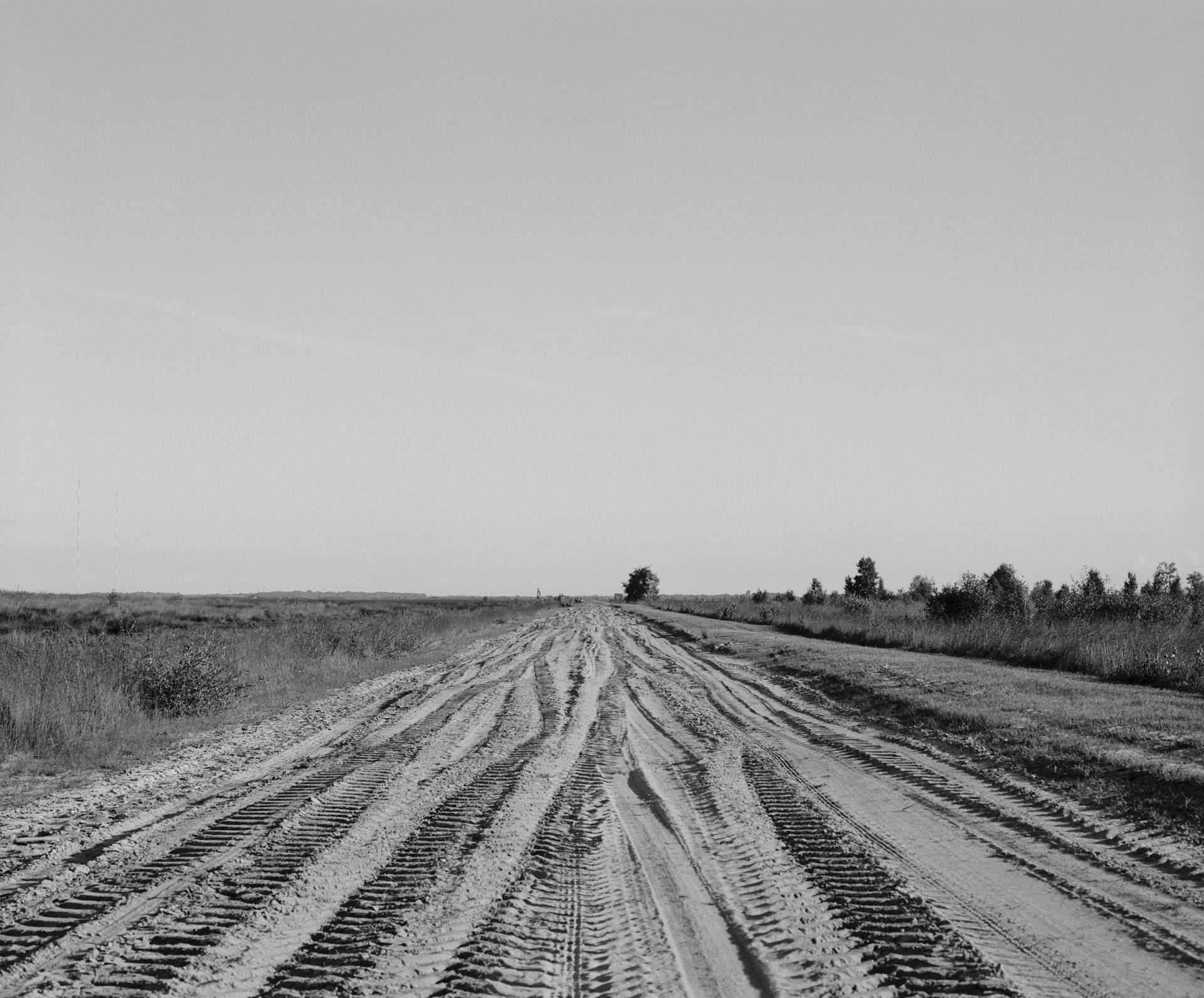
Working closely with the Emsland Lager Documentation and Information Centre and archive and local historians and Kralik's surviving relatives the project developed a rich understanding of the conditions of the camps and the contrasts and similarities between 1923 and 1933. Utilising infrared filters and photographic film capable of cutting through light fog and haze, the physical process of documentation references the process of aerial surveillance of the early Emsland camps.
Ten years after the peak of the German workers movement fascism came to power and Hanns Kralik was arrested and placed under indefinite detention or 'protective custody'. By July 1933 Kralik is one of the first victims of the newly constructed trial concentration camps located in the north of Germany, in the Emsland region. Each day Kralik and the mostly communist inmates are marched miles across the moor to harvest peat. Out of this experience 'Die Moorsoldatenlied' or 'Song of the Peat Bog Soldiers' is written initially by Johann Esser, and the first songsheet is illustrated and smuggled out of the camp by Kralik himself. The song quickly becomes an anthem of anti-fascist resistance despite all odds, in 1936 it was adopted by anti-fascist troops in the Spanish Civil War, as Kralik later wrote it took on folkloric proportions.

Esterwegen Woods
A mile down the road from the Börgermoor site stand the remains of the Esterwegen camp. The museum here only opened in 2011 a sign of West Germany and the current state's unwillingness to confront this first specifically anti-communist and anti-trade union wave of Nazi repression.
Known for a particularly savage camp guard the conditions at Esterwegen were brutal. Wolfgang Langhoff recounts the numerous reports of executions, starvation and torture. Whilst working on the moor Börgermoor inmates would throw scraps of food into the passing prison vans from the camp. The woods around Esterwegen became the site of routine executions, prisoners would be brought into the woods on the pretence of collecting firewood and then shot for desertion. Kralik was fortunate enough to be released from Börgermoor through a bureaucratic error and ultimately avoided Esterwegen. He would go on to join the French resistance during the war and afterwards became cultural secretary for Dusseldorf until 1951 when he became victim to the anti-communist legislation of the Adenauer Decree. Kralik passed away in 1971 following health complications that were a product of his detention at Börgermoor, leaving behind a legacy of determined artistic and poltiical struggle.
Share this project

A link to this page has been added to your clipboard