- CollegeLondon College of Fashion
- CourseBA (Hons) Costume for Performance
- Graduation year2025
This project was an interpretation of the Selkie myth, where a creature that can shift between human and seal forms has their sealskin taken away.
Here, I used the idea of the sublime (prevalent in the 1830s) to explore femininity and identity.
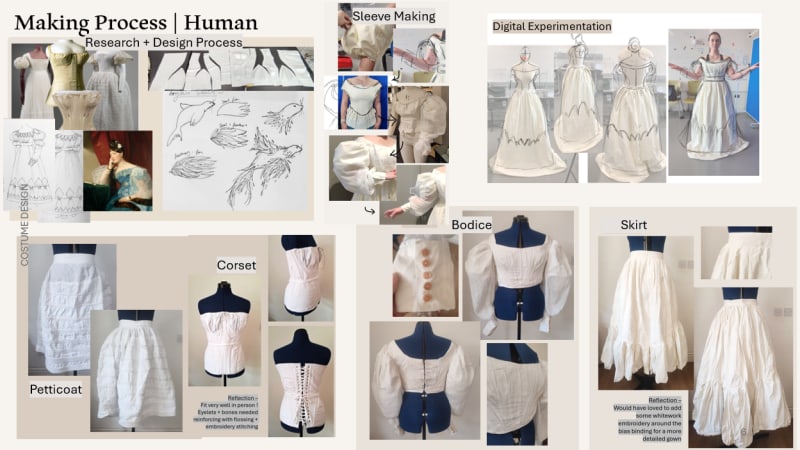
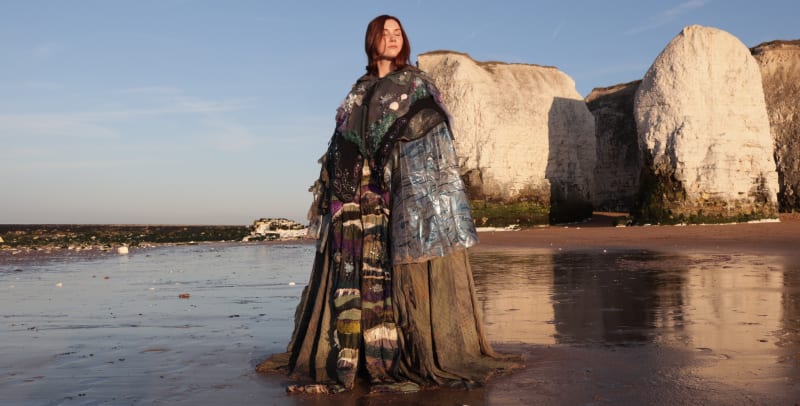
I created an 1830s wedding dress for the Human version of the Selkie. The Sealskin cloak is inspired by historical silhouettes of mantles, pelerines, and embodies the Selkie’s soul – with all things magical and marine.
Final work
Walk into the Sea

Walk into the Sea - Still



Research and process

In my interpretation of the Selkie myth uses Conner (2009) and Arya’s (2014) ideas to denote the sealskin as a ‘soulskin’ (as explored by Pinkola Estes, 2022).
The sealskin in the story represents the Selkie’s soul as it is symbol of her inner self, that she chose to share to society in her removal of it.
The husband in this tale conveys the Partiarchy, as he is the monolithic figure of ‘man’ for the Selkie, her only perception of one in the world. In taking her skin, he is forcing the Selkie to conform to social pressures of gender identity – to perform her domesticated role for him. While she settles into this, there is a feeling of something being wrong.
I think this shows the feminine dichotomy of the ‘self’, a dualism of wanting to be feminine and conformist, and wanting to be outside of this (the inner/ outer self). The ‘conform’ does not have to be conscious, with social and biological factors in play to create the idea of a woman, it is hard to discern what is/ can be the ‘true self’ and what is conforming to other pressures present from birth. The Selkie represents this struggle, she loves her children but feels disconnected from them. She wants to be a part of society yet choses to leave. She dons her seal skin, and removes it. The cycle of turmoil continues.
This is where I propose the idea of ‘finding one’s self’, as it connects all parts of this struggle. In gender theory , Butler (1990) describes how gender is performed, a term in process, a becoming. In this performance, I would argue there is a conscious choice of what aspects of femininity someone wants to do. To find one’s self is to single out what femininity means to you, and how you exist in the world.
The soulskin is emblematic of all of this, soft fragile feminine layers, in a chaotic mess of otherworldly and grounded in nature, it defines and undefines all aspects of what identity means to me.