
- CollegeCentral Saint Martins
- CourseBA (Hons) Graphic Communication Design
- Graduation year2025
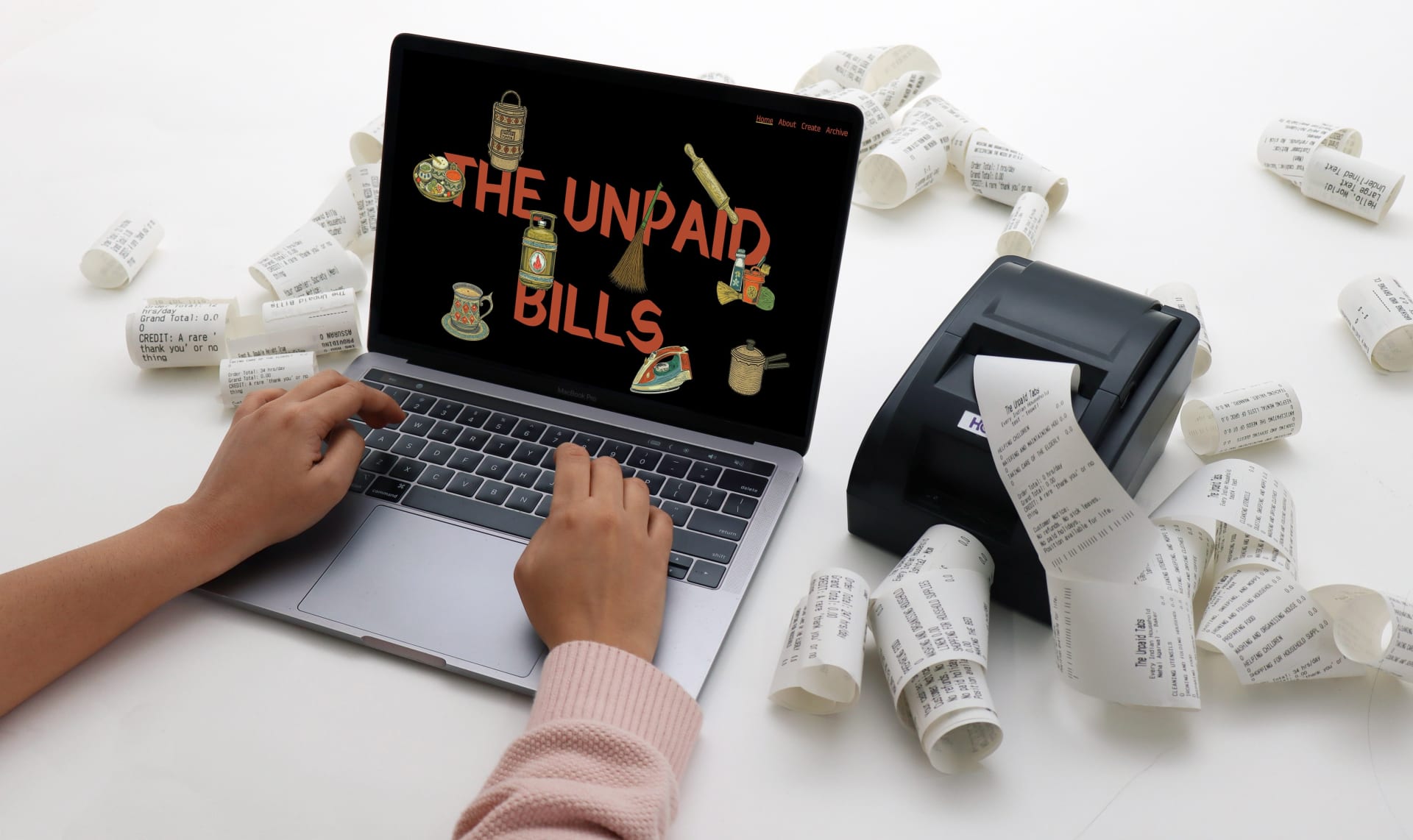
In many Indian households, daily life runs on the invisible, unpaid labour of women. The Unpaid Bills confronts this hidden economy by making tangible the emotional and physical work women perform without recognition: cooking, caregiving, cleaning, planning, and more.
The project consists of a website that allows women to document and visualise their labour as "unpaid invoices," while subtly confronting the men who benefit from it. Through soft, textural illustrations of domestic objects and pointed reflection questions, the project exposes the exhaustion behind every unacknowledged task.
Rooted in lived experience, The Unpaid Bills challenges societal norms, invites reflection, and asks: who is truly accountable? It is a call to recognise, value, and honour the work that has long gone unnoticed.
Final work


Two juxtaposed frames evoke a transactional lens on unpaid domestic labour. On the left, a self-service touchscreen kiosk displays The Unpaid Bills website interface, mimicking the design of fast-food or shopping terminals. It invites users to “create” their own bill a digital reframe of care as labour. On the right, a hand holds a long receipt while grocery shopping, but instead of food prices, the receipt itemizes emotional and physical labour: “wiping tears,” “thinking of meals before they’re requested,” “listening without interrupting.” Together, these visuals collapse the mundane with the radical reimagining daily, invisible work as something that could and should be accounted for.
Research and process


Share this project

A link to this page has been added to your clipboard