

- CollegeCentral Saint Martins
- CourseMA Fine Art
- Graduation year2025
In exploring the records and archives of memory, I turn to material memory—held in objects and passed through generations. ‘Nani ka dupatta- remnants of a separation’ is one such heirloom: a handcrafted, embellished fabric made in pre-partition India, worn by my grandmother on her wedding day and later passed down to my mother, myself, and now my daughter. This fabric has crossed borders and histories, surviving the trauma of partition and migration to England. It carries the imprint of every hand that has touched it —witnessing generations of dreams, fears, and lived constraints.
It also becomes a symbol of the layered expectations placed on women belonging to South Asian heritage: the roles they are expected to perform, the burden of tradition, and the silent erasure of agency within patriarchal systems. I will be installing this fabric alongside a graphite portrait of a woman from a marginalised background—foregrounding the complex intersections of class, gender, and cultural legacy in our social fabric.
Final work
Nani ka Dupatta - Remnants of a Separation
For my degree show, I set out to create a multi-sensory installation that reflected the different elements of my practice—drawing, sound, image, and installation—while centring material memory. I wanted to bring together my research and contextualise the themes I’d been exploring across various works. I decided to encase my grandmother’s dupatta in clear acrylic to protect and display it. This choice prompted a deeper reflection on the semiotics of flattening an object—evoking associations with museum displays and the treatment of artefacts behind glass.
To preserve the fabric’s softness and sense of movement, I printed a related photograph onto organza silk and layered it with the encased textile. I added a one-minute sound piece of my mother singing an old Indian film song, which played intermittently, and scented the space with jasmine oil perfume. Together, these elements created a space of sensory nostalgia, echoing a distinctly South Asian aesthetic and carrying forward the layered histories embedded in the object.
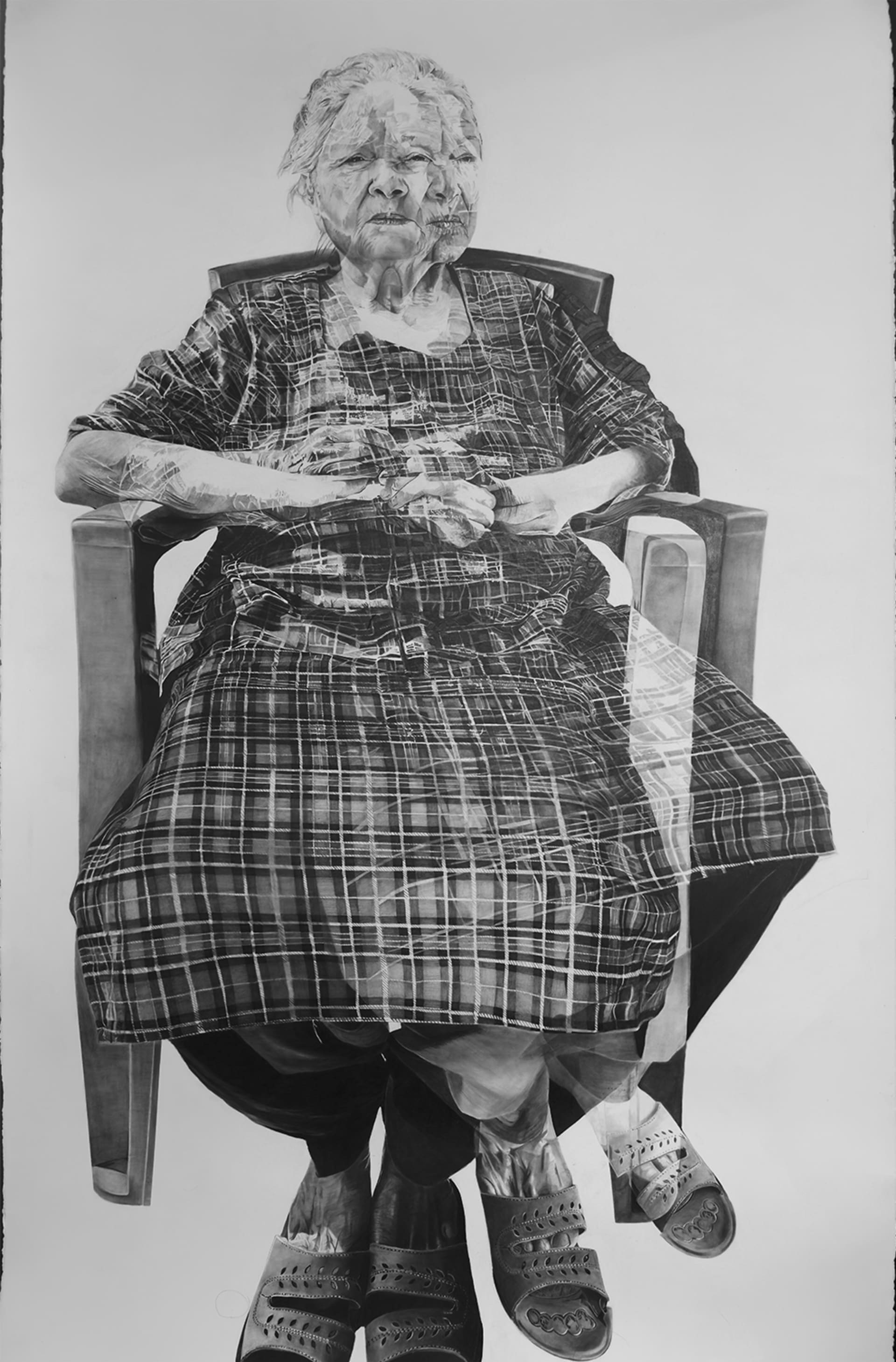
Ami
Graphite drawing on arches paper
115cm x 180cm
This work explores themes of memory, identity, and the passage of time, centering on the figure of an elderly woman rendered with layered, double-exposed imagery. The duplication and shifting of her features evoke the fragmentation of memory and the complexity of lived experience, particularly within intergenerational and diasporic contexts. The meticulous depiction of her patterned dress contrasts with the spectral overlay of her face and hands, suggesting both presence and absence—an embodiment of fading histories, resilience, and the quiet endurance of matriarchal memory. The work invites reflection on aging, visibility, and the layered narratives carried within the body. The distortion evokes a sense of memory, time, and presence, as if the figure exists in multiple moments at once. The expression on her face is calm yet intense, conveying strength, resilience, and reflection. The background is plain, drawing full attention to her presence.

Rania
This deeply personal work explores the intersection of collective memory and intimate generational connectedness. This image captures a layered meditation on inheritance, memory, and identity through the intimate gesture of the artist’s daughter wearing her great-grandmother’s dupatta, creating a poignant visual bridge across four generations. Presented as a dual composite, the photograph layers presence and absence, visibility and trace, echoing the complexities of diasporic memory. Printed on translucent silk, the image evokes both the fragility and resilience of cultural inheritance. Through fabric, gesture, and gaze, the work meditates on how matrilineal histories are embodied, passed down, and quietly sustained within South Asian Muslim female experience across time and distance.The image depicts the artist’s daughter wearing her great-grandmother’s dupatta, creating a poignant visual bridge across four generations. Presented as a dual composite, the photograph layers presence and absence, visibility and trace, echoing the complexities of diasporic memory. Printed on translucent silk, the image evokes both the fragility and resilience of cultural inheritance. Through fabric, gesture, and gaze, the work meditates on how matrilineal histories are embodied, passed down, and quietly sustained within South Asian Muslim female experience across time and distance.
Research and process

Reserach for my Project
I came to recognise that my mother’s way of preserving memory was rooted in holding on to objects, collecting old photographs, and sharing stories through oral recollection. I began to mirror her process, photographing the familiar domestic spaces of my childhood home and curating selections from our family’s photographic archive. I unearthed an old heirloom, a dupatta worn by my grandmother on her wedding day. My process involved spending time sitting with these objects, contemplating the layered stories they held. This became an intimate act of material memory archiving, a way of honouring and reimagining familial narratives through touch, image, and reflection.

Riso print of my family's hierloom.
I wanted to explore ways of connecting my mother’s portrait with my daughter’s photograph through the shared fabric, drawing on the material as a symbolic link across generations. Building on my earlier silkscreen work with the burqa, I aimed to translate the physical presence of the fabric into an image. I scanned a section of the textile and used it to create a Riso print, experimenting with papers of varying weights to replicate a fabric-like tactility. While the prints were visually effective, the transformation of the object into a two-dimensional image altered its meaning, shifting the focus away from its material and emotional significance. I realised it would be most effective to incorporate the actual fabric into the work.
Share this project

A link to this page has been added to your clipboard