

- CollegeCamberwell College of Arts
- CourseMA Interior And Spatial Design
- Graduation year2025
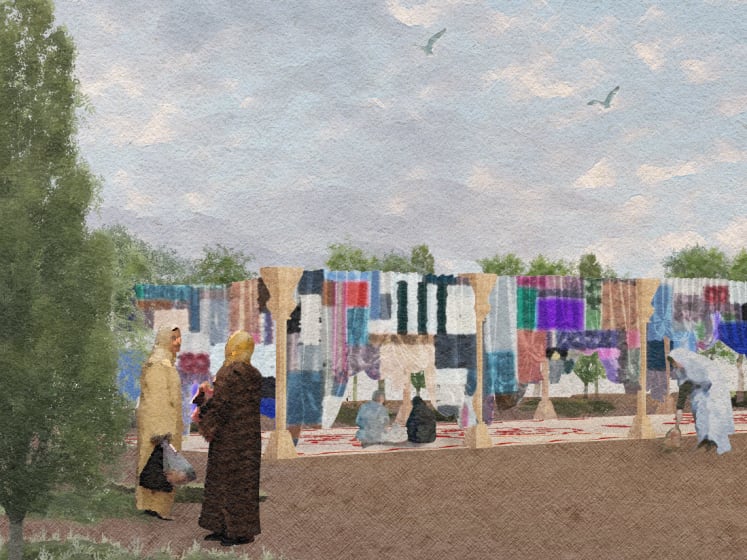
This project reimagines my grandfather’s neglected garden in my hometown, Evaz, as a communal installation that bridges past, present, and future. What begins as a study of abandonment and migration evolves into an architectural proposal rooted in Persian garden philosophy, textile traditions, and everyday rituals. A minimal floor textile, patterned with symbols of life, death, and renewal, anchors the space, while carved wooden pillars record Evazi words that trace a human lifespan. Above them, a canopy of repurposed garments stitches personal histories into a collective sky.
The work draws on archival memory, scent studies, and material experiments guided by the principles of adaptive reuse. Through gathering, eating, and resting, the installation reconnects people to a place shaped by absence yet sustained by care. It does not rebuild the past but opens a space for the community to imagine how the garden can come alive again.
Final work

Assembling the Layers.
This axonometric sequence unfolds the installation layer by layer: the grounding textile, the carved pillars, the canopy of garments, and finally the people who bring the space into being. Shown as a gradual build-up, it reflects how the project moves from memory into form, revealing a spatial language shaped by lineage, care, and the rhythms of communal life.

A Place for Gathering.
The installation holds the small intimacies of daily life: a sofreh laid for breakfast, a round of cards between friends, the quiet concentration of a board game. Each act draws bodies closer, anchoring the space in repetition and routine. During Nowruz, the haft-sin sofreh turns the same surface into a ceremonial ground of renewal. On other afternoons, it softens into leisure: people lounging beneath the canopy, cracking sunflower seeds, letting time slow in conversation. It is also a place of small labours and gentle returns: washing produce, reading under filtered light, tending to what has grown. Each gesture restores the bond between land, labour, and rest, a rhythm the installation is shaped to hold.
Bāgh-e Bākhāle: Where the story began.
This short film moves through the garden’s shifting states: the path that leads inward, the moments when it was lived in, and the stillness that settled as it fell into neglect. Archival footage recalls a past filled with family, sound, and movement, revealing what once shaped the space. Only after this return to memory do we see gestures toward the future, garments laid out and opened, suggesting how the garden may be reactivated through care and community. The film becomes a quiet passage between eras, showing not just what remains, but what may yet return.

Beneath the Cloth, Between Conversations.
Beneath the gentle sweep of the canopy, people gather, laughing, resting, sharing, bringing the garden back to life. The installation becomes more than structure; it is a vessel for connection, weaving community and nature together in harmony, a living testament to the rhythms of daily life and collective care.
Research and process
Share this project
A link to this page has been added to your clipboard