

- CollegeCentral Saint Martins
- CourseMA Industrial Design
- Graduation year2025
How often do you think about your inevitable end?
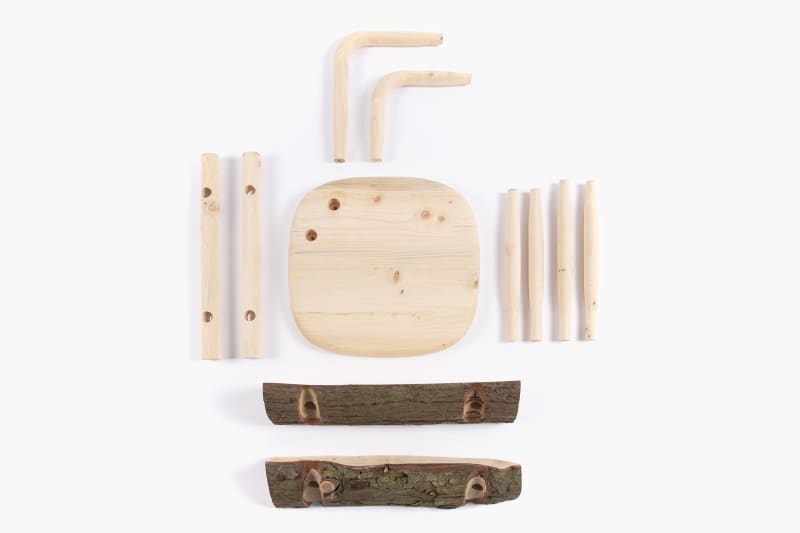
Sati (สติ), a Thai word meaning ‘to remember’, ‘to recollect’, or ‘to bear in mind’, is a wooden chair that profoundly embodies on existentialism and the fears of death. Influenced by the Zen methodless method of ‘just sitting’, it encourages people to just sit down for a moment, to let go of daily striving and simply sit with no objective. The unevenness of the legs encourages the user to utilize their own legs as support and gives complete control over stabilization not to tip over, a reminder of being here, being fully present in the moment and aware of our own self, body and mind.
Made from a fallen tree in Brent, London, this non-religious chair carries with it a memory of the time spent here in this city. Just as we grow old, the chair also ages over time, gaining scars and marks that reflect a life lived, lessons learned, and the beauty of being alive. When our path reaches its end, whether buried in soil or scattered to ash, we will return to the ground and become part of what is remembered, not what remains.
Yet, in this letting go, there is reassurance: nothing is ever truly lost from the face of Earth. We simply rejoin the ‘cycle of life’, to be transformed and begin again in a new form.
Final work

Sitting, in itself, carries a deeper meaning. It signifies rest, grounding, and stillness. In meditation practices, sitting on a chair is often the most accessible posture offering a sense of stability for everyone even for those who may have difficulty sitting on the ground.
Sitting up straight confers some practical benefits as well. By aligning the spine and opening the channels that run through the center of the body, upright sitting encourages an unimpeded circulation of energy, which, in turn, contributes to wakefulness on all levels - physical, mental, and spiritual.
This project explores how the simple act of sitting can help individuals calm their mind and be present in the moment. It is important to note that the intention is not to design a meditation chair, but rather an everyday chair, one that even in the briefest moments of use, it gently reminds the user to be present and grounded.




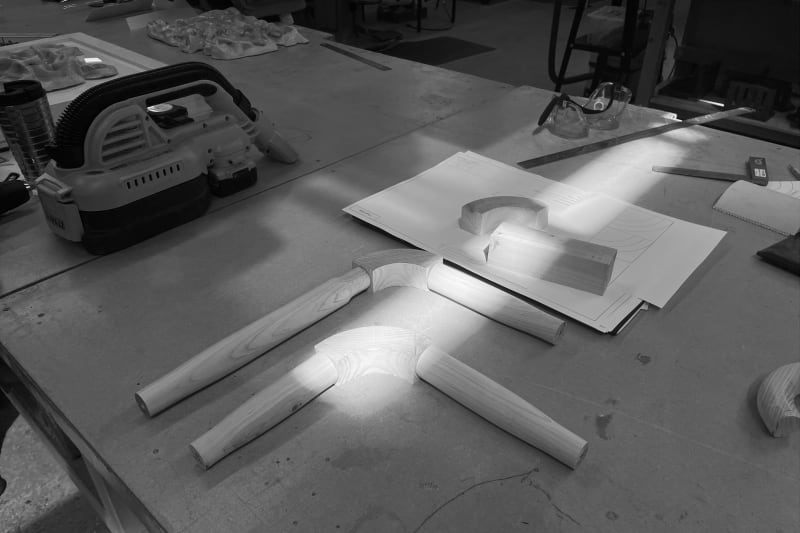
Research and process
Sati : Existentialism & Fears of Death — Central Saint Martins (2025)
How often do you think about your inevitable end? Sati (สติ), a Thai word meaning ‘to remember’, ‘to recollect’, or ‘to bear in mind’, is a wooden chair that profoundly embodies on existentialism and the fears of death. Influenced by the Zen methodless method of ‘just sitting’, it encourages people to just sit down for a moment, to let go of daily striving and simply sit with no objective. The unevenness of the legs encourages the user to utilize their own legs as support and gives complete control over stabilization not to tip over, a reminder of being here, being fully present in the moment and aware of our own self, body and mind. Made from a fallen tree in Brent, London, this non-religious chair carries with it a memory of the time spent here in this city. Just as we grow old, the chair also ages over time, gaining scars and marks that reflect a life lived, lessons learned, and the beauty of being alive. When our path reaches its end, whether buried in soil or scattered to ash, we will return to the ground and become part of what is remembered, not what remains. Yet, in this letting go, there is reassurance: nothing is ever truly lost from the face of Earth. We simply rejoin the ‘cycle of life’, to be transformed and begin again in a new form.


Share this project

A link to this page has been added to your clipboard