- CollegeCentral Saint Martins
- CourseM ARCH: Architecture
- Graduation year2022
Maison/0 Green Trail Award: Winner
MullenLowe NOVA Awards: YourNOVA Winner
The Honourable Harvest is an architectural and land-use design project developing a Reforestation Institute in Kaduna, Northern Nigeria. Utilising indigenous construction methods and traditional materials, the design aims to accompany the reforestation efforts in the wider Sahel Region, West Africa. Through spatial design, resource planning and cyclical farming practices, this scheme revives climate-resilient local economies and customs that are ecologically restorative and culturally informed. The Honourable Harvest aims to promote reciprocity, respect and reverence for the living and non-living natural world.
Final work

Reimagining Zaria City, Kaduna State, Nigeria
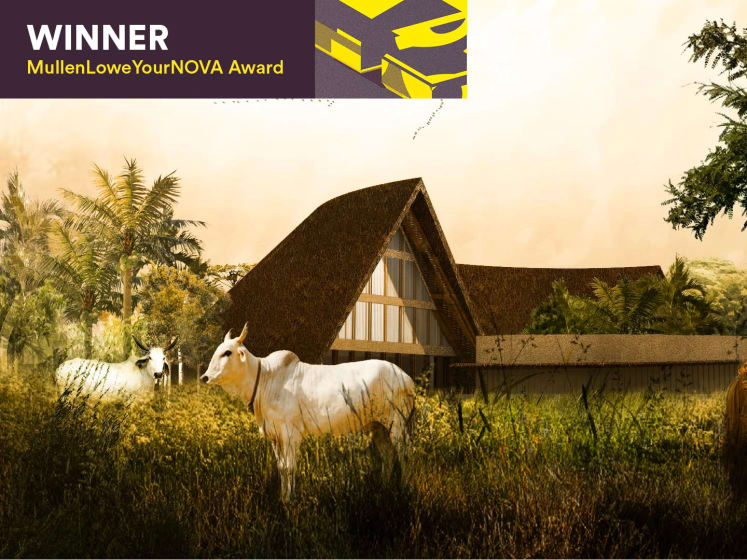
The speculative Reforestation Institute is located in the Ahmadu Bello University Farm in Zaria. Grappling with the immediate effects of unsustainable farming practices and soil degradation, the ingress of the urban farm currently sits semi-arid and underutilised. Situated between the faculty of agriculture and the veterinary sciences department, the proposed earthen building is an assembly space enveloped by the verdant reforested land. Carefully partitioned into agroforests, rotational grazing pastures and sacred groves — the site adopts a mosaic of different land uses to promote biodiversity, soil health and local economic growth. This, in turn, creates a resilient, fertile landscape which can resist the encroaching sands of the Sahel.
The Reforestation Institute is a place of assembly for all stakeholders and stewards of the land. This includes cattle herders, pastoralists, ecologists, clergy people and the wider community to negotiate the use of the land and adopt regenerative and restorative land-use practices. Different farming, planting and cattle rearing techniques are researched, tested, and taught at the institute. The scheme sets a methodology for realising viable alternatives to extractive land practices for the economic and environmental [re]generation of the community.

Securing Food Systems in Semi-Arid Regions
The Honourable Harvest explores sustainable farming practices, both indigenous and imported, that improve soil fertility, robust tree canopies and healthy understorey vegetation such as shrubs, herbs, grasses etc. Traditional land revitalisation methods include land-ripping and the formation of zai pits. During this process, green manure and termites are introduced to small soil mounds to burrowing tunnels, further breaking up the hard earth and improving water absorption. This affordable method is one of the many examples of accessible permaculture methods that can undo the effects of desertification and soil degradation.
The research explores the material potential of abundant biomass generated from agricultural processes and plant life. As a response, the project speculates the strategic use of regenerative natural resources in combating Sahelian desertification. Presently, the desert expansion is depleting arable land, causing food insecurity and drought; displacing communities from the Lake Chad Basin. According to the United Nations, Nigeria has the highest primary deforestation rate in the world; losing approximately 400,000 hectares of virgin forests per year. The Honourable Harvest aims to remedy environmental issues through land-based learning, agricultural research and knowledge sharing.
As a meeting place between herders, farmers, agronomists etc. the Reforestation Institute advocates for mixed land-use practices. The long-term health of the environment rests on creating a mosaic of farmland, rotational grazing paddocks, mature forests, edible gardens and fallows (resting land). The distribution of the land is regularly renegotiated according to the changing needs of the people, the changing seasons and the shifting microclimate. The mature urban forest would allow the people of Zaria to be self-sustaining decision-makers influencing their food supply chain and livelihoods.

Traditional Materials & Design Innovation
The building has been designed to last the duration of the early and formative stages of reforestation, such as land remediation, planting and maintenance until the forest matures (0-25 years). Following this period, the maintenance of the building rests on a reciprocal relationship with the forest as the materials for the building are directly derived from the surrounding ecology.
For example, the reforestation institute encourages farmers to feed cattle with silage during the dry season— the 'pickled' feed made by fermenting foliage. The silage is made by mixing grass with molasses derived from sorghum sugarcane grown in the agroforest. The waste stalks of the sorghum crop are then dried and used to rethatch the roof of the main building and the portico of the entrance hall. This is a brief description of one of many multi-directional, closed, material loops; illustrating functional reciprocity between the architecture and its surrounding ecology.


Research and process

Cyclical Building Materials
In the precolonial era, traditional groves were sacred spaces reserved for the worship of deities. The groves were forested areas at the periphery of the city reserved for the worship of deities. Activities such as farming, hunting, fishing and felling of trees were strictly prohibited in the sacred forests and this helped conserve the land and maintain the primary high forests. Today, such customs are hard to identify in the modern-Nigerian landscape. Informed by various indigenous cultures and sacred forms, the design of the institute utilises traditional thatch roofing, wattle and daub walls and compressed earth brick to highlight the beauty and functionality of local, biobased materials.